Chronic dizziness and a sense of imbalance are among the leading issues diminishing the quality of life for modern individuals. If you find yourself asking, “Everything looks normal, so why does the ground still feel like it’s slipping beneath my feet?”, the answer may lie in your body’s sensory organization. Today, the SOT (Sensory Organization Test) in diagnosis and Virtual Reality (VR) technology in treatment are opening a brand-new chapter in managing balance disorders.
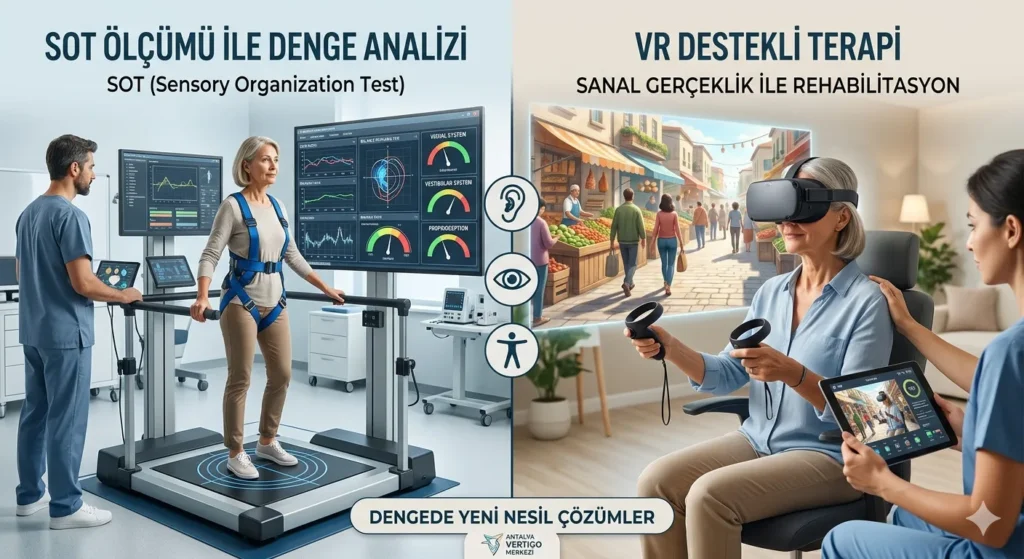
Balance Analysis with SOT (Sensory Organization Test)
To maintain an upright posture, our bodies rely on three primary sources: the eyes, the inner ear, and the joints. In balance disorders, the core issue is determining which of these three systems is sending incorrect signals to the brain.
What does the SOT Test reveal?
- Root Cause Identification: It clearly pinpoints whether the source of dizziness is the vestibular system (inner ear), visual illusions, or the musculoskeletal system.
- Fall Risk Prediction: Especially in elderly individuals, it uses scientific data to predict the likelihood of future falls.
- Personalized Roadmap: Instead of “one-size-fits-all” treatments, a rehabilitation process is initiated based on the test results, focusing specifically on the patient’s weakened sensory input.
Digital Transformation in Balance Rehabilitation: VR Technology
In the past, balance exercises consisted of simple lists on a piece of paper. Now, thanks to Virtual Reality (VR), patients can immerse themselves in real-life scenarios without ever leaving the clinic.
Advantages of VR-Based Therapy:
- Safe Simulations: Patients can experience anxiety-inducing situations—such as walking through a crowded shopping mall or climbing stairs—in a controlled environment with zero risk of falling.
- Brain Adaptability: Virtual worlds created through VR headsets enable the brain to reinterpret balance signals, a process known as neuroplasticity.
- Challenging the Inner Ear: By manipulating the visual environment, VR forces a “lazy” inner ear to work harder, effectively breaking “visual dependency.”
- Engaging Recovery: Since the process is transformed into a game-like experience, patient motivation and adherence to the treatment reach maximum levels.
Why Should You Seek Expert Support?
Every individual experiencing a balance disorder has a unique story and biological needs. Antalya Vertigo Center maps out the digital blueprint of the problem using the SOT test and aims for permanent, rapid recovery through VR rehabilitation and other modern techniques.
Remember; dizziness is not your destiny. It is simply a coordination problem that needs to be solved with the right technology. You can leverage the power of science to start seeing the world as stable and clear once again.