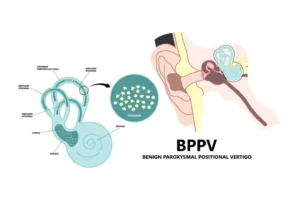
Have you ever woken up one morning with no warning and felt as if the whole world were spinning rapidly—like you were on an amusement‑park ride? And unlike benign paroxysmal positional vertigo (BPPV, “crystal displacement”), the spinning doesn’t stop within seconds, but lasts for hours or even days?
If your answer is yes, you may be experiencing Vestibular Neuritis (inflammation of the balance nerve).
So what causes it? Is it permanent? How can you speed up recovery? Here’s what you should know about vestibular neuritis.
What Is Vestibular Neuritis?
Inside the inner ear, there is a nerve that carries balance information to the brain: the vestibular nerve. When this nerve becomes inflamed—most often due to a viral infection and sometimes due to circulation‑related problems—incorrect signals begin to reach the brain. While your eyes report that you are still, your brain is being told that your body is moving. This conflict can lead to one of the most intense forms of vertigo.
How Is It Different From “Crystal Displacement” (BPPV)?
The easiest way to distinguish these two commonly confused conditions is by their duration:
- BPPV (Benign Paroxysmal Positional Vertigo): Starts only when you move your head and typically ends within 30–60 seconds.
- Vestibular Neuritis: The spinning can continue even when you keep your head still and may last for days.
What Causes It? (Triggering Factors)
Vestibular neuritis often seems to start “out of the blue,” but common underlying triggers include:
- Viral infections: Often occurs after a simple upper respiratory infection (flu, common cold) or after reactivation of herpes viruses.
- Immune system response: The body’s defense system may mistakenly attack the nerve.
- Seasonal transitions: It is seen more frequently during periods when viral outbreaks are common.
Symptoms of Vestibular Neuritis
Symptoms can be sudden and frightening:
- Severe, persistent vertigo: An intense spinning sensation that does not let up for 24–48 hours.
- Nystagmus: Involuntary eye movements (side‑to‑side or up‑and‑down).
- Nausea and vomiting: Common, especially during the first days of the attack.
- Loss of balance: Difficulty standing or walking; feeling pulled to one side.
- No hearing loss: If vertigo is accompanied by hearing loss or ringing in the ear (tinnitus), conditions such as labyrinthitis or Ménière’s disease should be considered.
Treatment and Recovery
Treatment is typically approached in two phases:
1) Acute Phase (First 3 Days)
The goal in this phase is to control severe nausea and vertigo. Doctors may prescribe vestibular suppressants and, when appropriate, corticosteroids. These medications should generally be used only for the first few days, because the brain needs to adapt (compensate). To allow this compensation to occur, suppressants must be discontinued as soon as possible under medical guidance.
2) Recovery Phase: Vestibular Rehabilitation
The brain is remarkably adaptable. Even if the balance nerve on one side is not functioning, the brain can learn to rely on the other ear and restore stability—this is called central compensation. To speed recovery:
- Try to get up and walk as early as possible instead of staying in bed for long periods.
- Do not neglect the eye‑ and head‑movement exercises recommended by your clinician (e.g., Cawthorne–Cooksey exercises).
- If needed, start balance rehabilitation with a specialist audiologist or vestibular therapist.
When Will I Feel Better?
The most intense spinning usually improves within 2–3 days. However, lingering unsteadiness, imbalance with quick movements, or “blurred vision” can take several weeks—and sometimes a few months—to fully resolve. Patience and consistency with exercises are key.
Remember: Vestibular neuritis is usually not a recurrent condition. After a single episode, the body typically compensates and recovers.