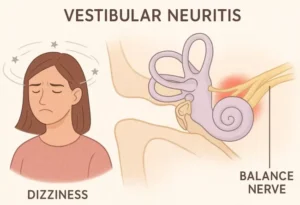
In the inner ear, there are fluid‑filled semicircular canals responsible for balance. At their entrance are otoconia (calcium carbonate crystals) that help the body sense gravity.
These tiny crystals are meant to stay in place. When they become dislodged and migrate into a semicircular canal, moving your head causes the fluid in that canal to shift abnormally. The brain interprets this disturbance as vertigo (a spinning sensation).
What Causes It? (Triggering Factors)
Although the exact reason the crystals move is not always clear, the most common causes include:
- Trauma: A hard blow to the head or sudden movements.
- Aging: Degeneration of inner‑ear structures with age.
- Prolonged bed rest: Lying in the same position for a long time after surgery or illness.
- Other inner‑ear problems: Previous inner‑ear inflammation (such as vestibular neuritis).
- Vitamin deficiency: Some studies suggest vitamin D deficiency may trigger BPPV.
Key Features That Distinguish BPPV From Other Causes of Vertigo
Not every episode of dizziness is BPPV. The following features help distinguish it from other vestibular disorders such as Ménière’s disease or vestibular migraine:
| Feature | BPPV (Crystal Displacement) | Other Vertigo (e.g., Ménière’s) |
| Duration | Very short (usually less than 1 minute). | May last for hours or days. |
| Trigger | Only with position changes (lying down, turning to one side, looking up). | Can start spontaneously, independent of position. |
| Associated symptoms | Usually no hearing loss or ringing (tinnitus). | Hearing loss, a sense of fullness in the ear, or tinnitus are common. |
| Nausea | Occurs during the spinning but is brief. | Can be more prolonged and severe. |
How Is It Treated?
The good news is that BPPV can usually be treated quickly with physical maneuvers—often without medication.
1) Diagnostic Maneuvers (Dix–Hallpike, Head Roll, Deep Head Hanging)
Your doctor or audiologist positions your head at specific angles and lays you back quickly. Video nystagmography (VNG) can be helpful because it allows clear observation of the eyes. If involuntary eye movements (nystagmus) appear along with typical symptoms, the diagnosis is confirmed.
2) Treatment Maneuvers
This is the most common treatment. The clinician rotates your head through a specific sequence of positions so the displaced crystals can return to where they belong (the utricle/saccule). Most patients improve significantly after a single session, with success rates around 80–90%.
3) Home Exercises
In some cases, your clinician may prescribe repeatable home exercises such as Brandt–Daroff exercises.
Important Notes
- After a maneuver, avoiding sudden head movements for a few days and not lying completely flat (sleeping with two pillows) may help prevent the crystals from migrating again.
- Instead of self‑diagnosing, consult an ENT specialist for the correct maneuver selection. A maneuver performed on the wrong side can push the crystals into more complex canals and worsen symptoms.