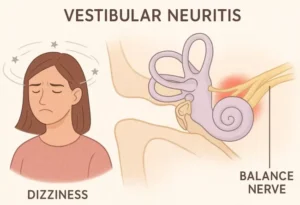
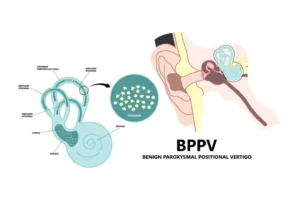
Virtual Reality (VR) technology has emerged from the gaming world to become the “new superpower” of the medical world, particularly in balance rehabilitation. For patients who are bored with traditional exercises and unable to make progress, VR essentially reprograms the balance system.
Here’s what you need to know about the use of VR (Virtual Reality) in Balance Rehabilitation, one of the most exciting topics in modern medicine:
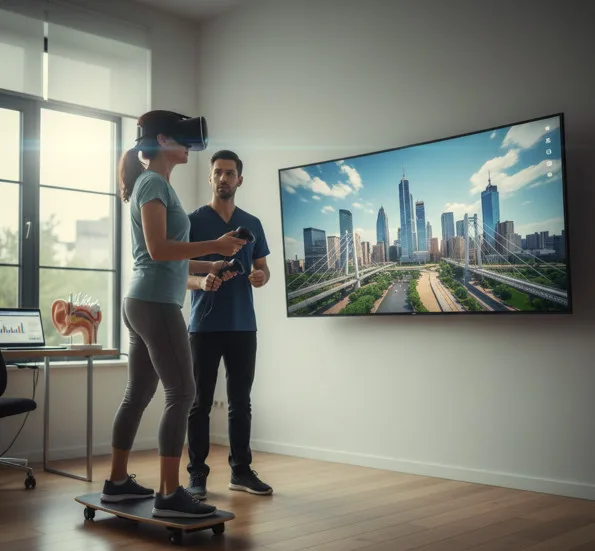
What is VR Balance Rehabilitation?
Traditional physical therapy exercises can sometimes be boring and demotivating. VR technology safely but deliberately places the patient in “unstable” environments. While the patient believes they are walking in a kitchen or balancing on the edge of a cliff, it actually strengthens the communication between their brain and inner ear.
How Does VR Work?
- Visual Deception: The VR headset sends false visual signals to your brain (for example, it makes it appear as if your surroundings are moving).
- Adaptation: The brain learns to focus more on signals from the inner ear and muscles to resolve this confusion.
- Neuroplasticity: The brain builds new neural pathways to maintain balance.
Which Conditions Can Benefit from VR Rehabilitation?
VR applications can work wonders, especially in diseases that are resistant to standard treatments or sensitive to visual triggers:
- After BPPV (Crystal Displacement): To eliminate that lingering ‘dizziness’ feeling even after the crystals have settled back into place.
- Vestibular Neuritis: Accelerates the brain’s compensation process following damage to the balance nerve.
- PPPD (Persistent Postural-Perceptual Dizziness): Helps patients overcome their fear of moving environments (shopping centres, busy streets).
- Migraine Vertigo: Used to reduce hypersensitivity to visual stimuli (visual vertigo).
- Age-Related Balance Loss: Ideal for overcoming the fear of falling and improving muscle coordination.
- Translated with DeepL.com (free version)
What are the Advantages of Using VR?
- Safe Testing Environment: Scenarios involving dizziness and the risk of falling in real life are experienced in VR with ‘zero risk’.
- Personalised Difficulty: The software adjusts the rotation speed or visual clutter according to the patient’s tolerance.
- Fun Factor: The patient forgets they are undergoing treatment and, because they are focused on goals within a ‘game,’ unknowingly performs thousands of balance exercises.
- Instant Feedback: Thanks to sensors, the direction in which the patient loses their balance can be measured down to the millimetre.
- Translated with DeepL.com (free version)
Frequently Asked Questions About VR Therapy
| Feature | Traditional Exercise | VR-Based Rehabilitation |
| Motivation | Low / Recurrent | High / Gamified |
| Visual Stimulus | Limited (e.g. looking at the wall) | Unlimited (Market, nature, city) |
| Data Measurement | Based on observation | Digital and precise reporting |
| Area of Use | Everywhere | Expert supervision and specialised equipment |
Caution: VR rehabilitation may not be suitable for every patient. Using VR during an active attack (acute phase) may increase nausea. Therefore, this treatment should only be started with the approval of an ENT specialist and an audiologist specialising in this field.